“Great resource with research grade examples. I used this for my thesis.”
The worksheets are structured very nicely and let me focus on the theory. Highly recommended for anyone tackling real engineering problems.
Learn to build physics-informed neural networks (PINNs) for dynamics, heat transfer and CFD. 27 hands-on PyTorch notebooks that run in your browser. Work through them in a weekend, and the skills are yours for good.
A real 28,000-epoch training run. The network only gets 12 noisy measurements from the first 0.4 s, plus the equation. The physics fills in the rest. The notebooks also show you how to make animations like this one.
A normal neural network only learns from data. With a few noisy measurements, it guesses badly everywhere else. A physics-informed neural network (PINN) is also trained on the governing equation, so its answer has to make physical sense across the whole domain.
In the animation above, the white dots are the only data. Everything the orange curve does after 0.4 s comes from the physics alone.
Match the measurements you have.
Obey the equation everywhere, even where there’s no data.
PyTorch autograd gives you the derivatives. The notebooks show you how, step by step.
Every lesson is a Jupyter notebook you can open in Google Colab. Colab is free and runs on Google’s computers, so it works on any laptop, even a work machine you can’t install software on.
def physics_loss(model, t):
    x    = model(t)
    x_t  = grad(x, t)
    x_tt = grad(x_t, t)
return ((m*x_tt + c*x_t + k*x)**2).mean()train(model, epochs=28000)
plot_prediction(model)Each notebook opens with a real engineering problem and the equation that governs it. No black boxes.
Use PyTorch autograd to take derivatives of the network and turn the equation into something it can learn from.
Train, compare against a known answer, and animate the learning. Stuck? Full answers are included for every exercise.
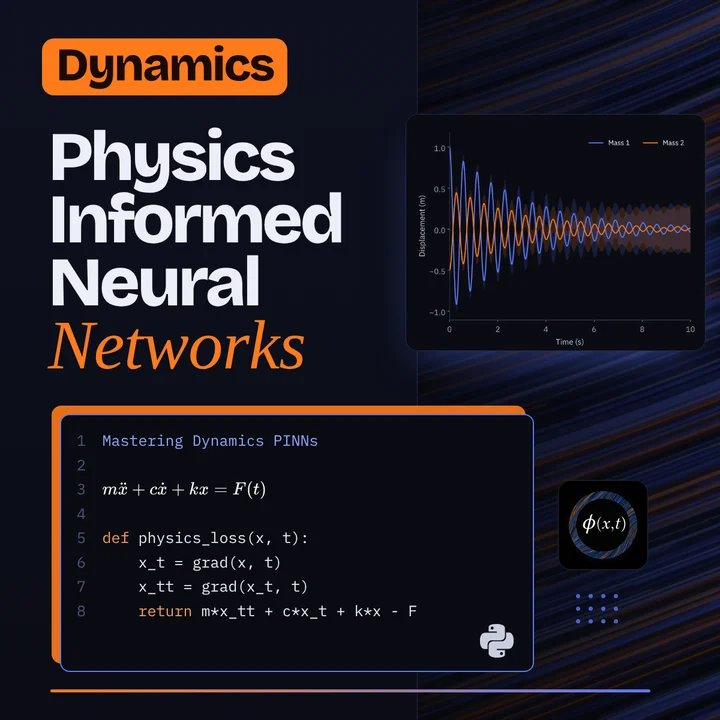
Vibrating systems from a single oscillator up to coupled masses.
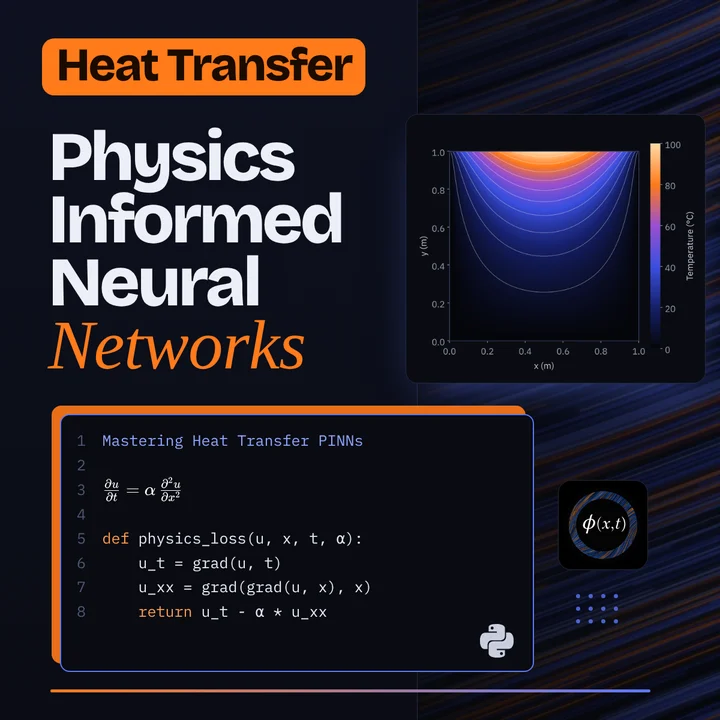
Conduction problems in 1D and 2D, and learning unknown material properties.
 Best seller
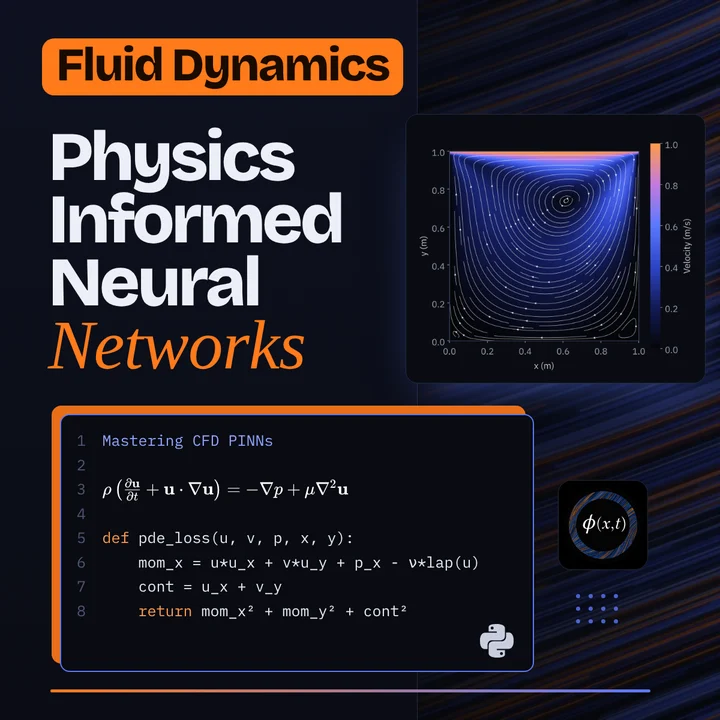
The Navier–Stokes equations, from classic benchmark flows upwards.
Each notebook is short and focused. Here’s one way to pace it.
9 notebooks. Your first PINN, then coupled masses.
8 notebooks. From 1D rods to 2D plates and unknown properties.
10 notebooks. Navier–Stokes and classic benchmark flows.
You know how to write any equation into a loss and train it.
A suggested pace. Go faster or slower as you like.
I share PINN examples, code breakdowns and animations on LinkedIn. Follow along and see if the way I teach suits you.
“Great resource with research grade examples. I used this for my thesis.”
The worksheets are structured very nicely and let me focus on the theory. Highly recommended for anyone tackling real engineering problems.
“Great introduction to PINNs presenting clearly physical and implementation details. Requires very little understanding of python and pytorch.”
“Excellent course! The worksheets made complex topics easy to follow and covered a lot of areas. Highly recommended for anyone wanting a practical introduction to PINNs.”
“I found Mastering CFD PINNs: A Coding Guide to be very insightful and well-structured. The explanations were clear, and the coding examples made complex concepts much easier to understand and apply. It’s a valuable resource for anyone looking to explore the intersection of CFD and physics-informed neural networks.”
“Very insightful both from a computational and from a physical perspective.”
I came to machine learning from mechanical engineering, so I know how steep the learning curve can feel.
These notebooks are everything I wish I’d had when I started: real engineering problems, clear physics, and code you can run, change and break. I’m sharing what I’ve learned so you can skip the frustration.
Prices in GBP. Secure checkout and instant delivery through Topmate.
Dynamics PINNs9 notebooks£19
Heat Transfer PINNs8 notebooks£19
CFD PINNs10 notebooks · best seller£19
Buying two? The package costs £10 less than two singles, and you get the third series too.
A physics-informed neural network is a neural network trained to satisfy a physical law, such as an ODE or PDE, as well as any data you have. The equation is built into the loss, so the network is penalised whenever its answer breaks the physics.
No. You can open every notebook in Google Colab and run it in your browser. If you prefer, they also run in your own Python setup with PyTorch and Jupyter.
You can work through all three series in a weekend. Each notebook is short and focused, so you can also do one at a time.
No. The notebooks start from the engineering problem and build up the machine learning step by step. Some basic Python will help.
An inverse PINN learns an unknown value in the equation, such as a thermal conductivity or a damping coefficient, from a few measurements. It’s useful when you know the physics but not all of the material properties.
Not in general. Traditional CFD is still faster and more reliable for most standard simulations. PINNs are most useful for inverse problems, combining sparse measurements with physics, and building fast surrogate models.
Open the first notebook in your browser and start this weekend.